Showing posts with label TECH. Show all posts

Feb 6, 2013

Knowledge is to be shared; not horded. Tribute to Aaron Swartz.

After reading the following article by late Aaron Swartz, I had this thought. Lot of us doing our higher ed has access to many peer reviewed journals, and after what the world of which we are a part, did to this wonderful person, his ideas shall only gain strength. I believe sharing knowledge is never a crime, rather its everybody's duty. Hence it would be great if everyone of us could help share the access to those who actually need the information for study and creative purposes.

"Guerilla Open Access Manifesto 

Information is power. But like all power, there are those who want to keep it for
themselves. The world's entire scientific and cultural heritage, published over  centuries in books and journals, is increasingly being digitized and locked up bya handful of private corporations. Want to read the papers featuring the most famous results of the sciences? You'll need to send enormous amounts to publishers like Reed Elsevier. 

There are those struggling to change this. The Open Access Movement has fought 
valiantly to ensure that scientists do not sign their copyrights away but instead ensure their work is published on the Internet, under terms that allow anyone to access it. But even under the best scenarios, their work will only apply to things published in the future. Everything up until now will have been lost. 

That is too high a price to pay. Forcing academics to pay money to read the work of their colleagues? Scanning entire libraries but only allowing the folks at Google to read them? Providing scientific articles to those at elite universities in the First World, but not to children in the Global South? It's outrageous and unacceptable. 

"I agree," many say, "but what can we do? The companies hold the copyrights, they
make enormous amounts of money by charging for access, and it's perfectly legal— 
there's nothing we can do to stop them." But there is something we can, something that's already being done: we can fight back. 

Those with access to these resources — students, librarians, scientists — you have been given a privilege. You get to feed at this banquet of knowledge while the rest of the world is locked out. But you need not — indeed, morally, you cannot —keep this privilege for yourselves. You have a duty to share it with the world. And you have: trading passwords with colleagues, filling download requests for friends. 

Meanwhile, those who have been locked out are not standing idly by. You have been
sneaking through holes and climbing over fences, liberating the information locked up by the publishers and sharing them with your friends. 
But all of this action goes on in the dark, hidden underground. It's called stealing or piracy, as if sharing a wealth of knowledge were the moral equivalent of plundering a ship and murdering its crew. But sharing isn't immoral — it's a moral imperative. Only those blinded by greed would refuse to let a friend make a copy. 
Large corporations, of course, are blinded by greed. The laws under which they operate require it — their shareholders would revolt at anything less. And the politicians they have bought off back them, passing laws giving them the exclusive power to decide who can make copies. 

There is no justice in following unjust laws. It's time to come into the light and, in the grand tradition of civil disobedience, declare our opposition to this private theft of public culture. 

We need to take information, wherever it is stored, make our copies and share them with the world. We need to take stuff that's out of copyright and add it to the archive. We need to buy secret databases and put them on the Web. We need to download scientific journals and upload them to file sharing networks. We need to fight for Guerilla Open Access. 

With enough of us, around the world, we'll not just send a strong message opposing the privatization of knowledge — we'll make it a thing of the past. Will you join us? 

Aaron Swartz 

July 2008, Eremo, Italy"
Rest in Peace Aaron

(November 8, 1986 - January 11, 2013)

By Sharath with No comments

Jun 30, 2012

onX: way to go Microsoft.

Microsoft has stunned everyone by launching this wonderful platform on{X}, that lets you write custom code and automate your Android phone... Wait did I just hear Microsoft + Android? Seriously?
Looks like it is happening and whatever happened, seems very good and promising so far!
The site's documentation page teaches you everything you probably want to know before you can start writing your own code.
A number of common recipes are also available for download on the website, for use right away.. The codeplex community for onX is just maturing and there is no doubt it will soon become the next big thing among geeks.

You need to install onX(~7MB) on your phone before you can start using it and writing custom codes online.Oh yeah, you write code online and push it to your phone (which is very simple in fact) so we can call this remote programming...


Shira Weinberg, the on{X} team’s Program Manager, explained that the less strict security model of the Android platform is well suited for deploying early stage technology previews. This means that on{X} should be expected to be implemented on Windows 8 and Windows Phone, which require a more mature implementation of the technology.
All users need to do is download the Android app and then configure rules on the on{X} site. Rules are called ‘recipes’ and there are 11 templates ready to go. These include ones such as ‘Launch the music app when I am walking’ and ‘Remind me to visit the gym if I haven’t been there in 3 days’. Check out the video at the bottom of the post for a demo.
Each recipe can be easily edited by novices before being pushed to the user’s device. The rules and all the data they hold are private, and are available only to the user.

By Sharath with No comments

Jun 6, 2012

My Pick: Windows phone; Cool Tool in the wrong hands!

Windows phone had been the hype-du-jour for the past few months. While admittting that it succeeded in creating its own fan-base, we should also point out that being proprietary has kept the potentials of this platform leashed to a the market interests of Microsoft.

Read this article about how the platform could have been made more attractive, now that Windows 8 is gonna come, this might be what you can expect.
Presenting… a vision of what Windows Phone 8 might look like: Read ON>>>

By Sharath with No comments

May 12, 2012

FLIPBOARD FOR ANDROID LEAKED!

Samsung had announced earlier that its latest gadget Galaxy SIII will have the Android version of the popular iPhone app flipboard.

Flipboard is a pretty app that collects the content of social media and other websites and presents it in magazine format and allows users to "flip" through their social-networking feeds and feeds from websites that have partnered with the company.
Originally designed specifically for the iPad, in December 2010, the application was updated to add support for the iPhone and iPod Touch. On May 5th 2012, it was announced that Flipboard would be released for select Android phones, beginning with the Samsung Galaxy S3.
It is produced by Flipboard, Inc., a United States-based software company founded in 2010 by Mike McCue and Evan Doll and headquartered in Palo Alto, California.
Unfortunately, the app was announced as Galaxy S III exclusive at launch, which meant the only way for you to get it is buy a Galaxy S III. Thankfully, though, one XDA user managed to extract it from the device and made it available to everyone right now. 
For download links, CliCk Here.

By Sharath with No comments

Apr 29, 2012

Learn Some Multimedia Skills. For Free!

While you spend all that spare time you get between your end-of -college and finding-a-job Facebooking eating and sleeping, you could actually arm yourself with some awesome multimedia skills like video editing and rendering, 3-D modelling etc.What more,you get to learn to use the industry benchmarks tools like Adobe AfterEffects, Autodesk Maya etc.AND its free!


FREE AfterEffects tutorials are being offered by Andrew Kramer at Video Copilot. Unlike other so-called free tutorials out there on the net, these are uber-cool, no-bullshit tutorials, and by far the best I have seen. They also don't stop in between and ask you to buy the rest and all. :D


Thanks once again to Andrew Kramer. Meanwhile you might want the latest After Effects software which you can find on our very own Pirate Bay.

As for Maya, you can get tutorials from Autodesk themselves here. Again back to Pirate Bay for the software. ;)
Enjoy the tutorials. Find out more. You never know when they will come in handy, but you sure would thank me when you do !


By Sharath with No comments

Apr 3, 2012

NEW HORIZONS IN BUSINESS ANALYTICS.


A new star is on the rise in the Data analytics horizon. Big guns who have monopolized the markets and ran the show the way they liked are now trembling before the sheer lightning-speed and performance of SAP HANA.

Short for High-performance Analytics Appliance, HANA combines a lot of what is “future technology” for its competitors, and SAP has done an excellent job pulling it off. In fact the entrance of HANA was so unexpected, even the competitors rolled out by Oracle and the lots are in no way a match for it.

SAP first announced its plans for working on in-memory databases at the SAPPHIRE conference in May 2011, and was immediately met with sharp criticism or rather sarcasm! Oracle CEO Larry Ellison, openly mocked SAP's goals during an event in January.
"Get me the name of their pharmacist," Ellison said at the time. "I mean, I know a lot about in-memory databases. In fact, we have the leading in-memory database, TimesTen. This is nonsense. There is no in-memory technology anywhere near ready to take the place of a relational database. It's a complete fantasy on their part."

In-memory databases store information in a system's main memory, instead of on disk, providing a performance boost. The technology, which Plattner also discussed at last year's Sapphire event, is now beginning to be reflected in SAP BI (business intelligence) products, such as BusinessObjects Explorer.

HANA is available in appliance form on hardware from a number of vendors. Built in part upon existing products at SAP, HANA places data to be processed in RAM, versus reading it off disks, which provides a performance boost.

SAP HANA runs on high-end commodity hardware and provided you have enough memory to run your database, it doesn’t matter what you run it on from a technology standpoint.
Initial certified hardware solutions are still quite expensive – I priced up a 1TB Dell system for $75k – not including disk storage, which will probably double that number at retail price, so think $150k. But really that’s nothing compared to what an equivalent 10TB database cost 10 years ago (SAP HANA compresses 10:1 compared to databases back then).
And worryingly for Oracle, Teradata, IBM and HP, it is nothing compared to what Mainframe or Teradata/Exadata hardware costs.

While HANA so far is positioned primarily for analytic workloads, SAP has long-term designs of porting its flagship Business Suite to the platform, a move that would provide an alternative for SAP customers currently running their transactional systems on databases from Oracle or IBM.
SAP had previously released a Strategic Workforce Planning application for HANA, which allows companies to analyze the effect of changes to their employee base. The new Smart Meter Analytics product will help utilities probe smart meter data for deep insights into customer energy usage patterns, allowing for improved system load forecasting, specialized marketing programs and other benefits, SAP said.
What does this mean for the future state of high-end systems? And in the emerging business world where the Big Data challenge is not just an isolated incident but a ubiquitous condition, is it not reasonable to expect that more and more customers will require more and more of these extremely high-performance machines?
REAL LIFE CASE-STUDYS
What does improved analytics speed mean for business? What is the value added to your business by pulling off super-fast reports and analysis from your databases? What if you could do cost and profitability analyses across millions of records spanning three years and thousands of retail outlets in less than 5 seconds—that is, in real-time—instead of in a few days? How would that change the ways in which you engage with customers, exploit the power of dynamic pricing, squeeze inventory volumes, and accelerate your moves into new markets?
How about a factor of 1,000: what if your systems could give you deep and granular insights into every phase of your business 1,000 times faster than they currently do—how would you exploit all that speed, all that customer-driven foresight, all that potential?

Only a year or so ago, all of these questions would have been largely theoretical simply because traditional IT systems and architectures were limited to delivering only incremental increases in performance, and gains of 25% or 35% were huge.
HANA enhances or rather expands old-school analytics in five dimensions. In the words of SAP executive board member Vishal Sikka, these are:
1)Are we able to ask complex questions? This, Sikka said, means that value is unlocked not merely by crunching through the same numbers more quickly than before, but by “going deeper”: analyzing more records over more time with more variables, and getting answers hundreds or thousands of times faster.
2) Can we ask an unlimited range of questions without having to submit them in advance? Current systems require some preliminary staging of anticipated data sets, which greatly limits the types of questions that can be asked and, more importantly, the types of insights that can be gained. HANA, Sikka said, has no such limitations.
3) Can we interactively arrive at questions? In the old model, a limited set of questions is submitted to an expert who then triggers the analysis in isolation—conversely, Sikka is describing an entirely new dynamic that allows multiple people to look at and question the incoming results on the fly from an unlimited set of perspectives.
4) Are we able to ask questions across data sets that are not only huge, but come in various types: structured and unstructured, month-old and real-time? With absolutely no limitations?
5) And, can people from across the organization—not just BI black-belts—make these interactive inquiries in real time and get real-time answers? Can businesses finally unlock the potential and power within their data that for too long have been trapped in traditional systems that, intentionally or otherwise, give higher priority to internal processes than to customer requirements?


It all depends on which of these dimensions you chose to exploit, and how you go about doing it.
“Our friends at Colgate told me that with their live Hana system, they are now able to run some operational reports 1,000 times faster than before,” said VishalSikka during his keynote speech at SAP’s China SAPPHIRE NOW event in Beijing. The list doesn’t end there.
Nongfu Spring, a rapidly growing bottled-water company based in China whose use of HANA has enabled it to cut its calculation of transportation costs from 24 hours to 3.8 seconds, or more than 15,000x.
Even more astounding is the achievement of is Yodobashi, the electronics retailer in Japan, where 5 million of its 22 million customers are part of the company’s loyalty program. The calculation for rewards and incentives earned by those 5 million loyalty-club members used to take 3 days—but with HANA, it now takes 2 seconds. That’s an improvement of 125,000 times!
As a result, Yodobashi can now engage immediately and more intimately with those 5 million loyalty-club members while they’re still in the store and more likely to buy, which is a massive transformation in how the company can enhance its interactions with its best customers in real time.

“Yodobashi hits 3 of the 5 dimensions we have laid out,” Sikka said, “so just imagine what can happen if a company is able to execute across all five dimensions.”

In short term, we can see IBM posting higher profits from its mainframe sales, HP is in all sorts of organizational troubles and Oracle is focusing on Exadata. But the Mainframe market is set to start tailing off by 2015. Oracle already has an in-memory product called TimesTen in developement, but it is highly doubtful if it will be able to compete with HANA. As for Teradata, they need to realize the big challenge posed before them.

By Sharath with No comments

Nov 23, 2011

INDIA INNOVATES: SOME OF THE BEST INNOVATIONS FROM INDIA IN RECENT TIMES


The Indian technology industry got its start running call centers and doing low-level IT work for western firms. Then, in the 2000s, it started taking on higher-level IT tasks, offering management consulting services, and performing sophisticated R&D. Now there is another transition happening, one far more significant: a transition to development of innovative technology products. Instead of providing IT services as the big outsourcing companies do, a new breed of startups is developing high-value products based on intellectual property. The Indian industry group NASSCOM estimates that, in 2008, the country’s software product revenues totaled $1.64 billion. It forecasts that this will grow to $11 billion per year by 2015. -Vivek Wadhwa (TechCrunch)

Here are some of the hottest innovators from India  and their story.


H P Khincha
 K. Chandrasekhar of Forus Health.
Chandrasekhar learned that that the vast majority of the 12 million people in India who are blind could have maintained their sight if only their problems had been diagnosed and treated on time. The diagnostic equipment for a single hospital cost at least US$60,000—which put it out of the reach of most regional clinics—and required ophthalmologists to perform the diagnosis. Chandrasekhar and Forus cofounder Shyam Vasudev decided to leave their jobs as senior executives at NXP Semiconductor (an offshoot of Philips) to create an affordable, all-in-one, intelligent pre-screening device that is non-invasive and can be used by minimally trained technicians in rural India. The device provides an indicative report in 10 minutes for five major eye-related problems, including diabetic retina. This frees the doctor up to treat patients rather than administer tests. The product costs less than $15,000, and Forus expects the price to drop to half that in volume production.

Ajit Narayananand.
Ajit Narayananand (29 years)
Innovator of the Year
Ajit Narayanan, 29, exemplifies the spirit of innovation in India. Toiling for a few years at a startup, Invention Labs Engineering, incubated at the IIT (Indian Institute of Technology) Madras, Narayanan has developed an alternate communication system for millions of people who remain incommunicado with the society due to their disabilities.
Avaz
Avaz, (voice in Hindi) is the tool which uses a variety of software and hardware to provide a voice to these muted millions using just their muscle movements.
There are an estimated 10 million people in India who suffer from speech impediments. They may not have speech but they have a lot to say. And they can benefit from Narayanan's device. AVAZ is a communication device for people with speech disorders such as cerebral palsy, autism, mental retardation, and aphasia.
Avaz works by converting limited muscle movements, such as head or finger movements, into speech. His invention broadly falls under the category of Augmentative and Alternative Communication (AAC) technologies.

Alefia Merchant.
Alefia Merchant (32 years)
Humanitarian of the Year

Novel method of screening for eye disease in children under the age of five.

An estimated 1.4 million children in the world are blind and 90 percent of them are found in developing countries. In India, these children often face a lifetime of disability.

Poor vision affects every aspect of their lives - economic, social, and psychological. Ultimately, it undermines their function and acceptability in their families and in society.
If children with visual disabilities were detected sufficiently early, approximately 40 percent of such cases could be prevented or treated and the remaining could be rehabilitated to minimize the child's handicap.
In India, there are many hurdles in detecting, diagnosing, and treating such children. There is no organized screening program focused on identifying children under the age of five for sight-threatening eye conditions. The World Health Organization reports the lack of adequate community-based, primary-care screening programs as an important barrier to improvements in current morbidity and mortality rates due to eye-related diseases.
A novel method for eye-testing
Third year medical student at University of Montreal, Montreal, Canada, Alefia Merchant has developed a novel method of screening for eye disease in children under the age of five.
Merchant developed the method during September 2009 till June 2010 as part of her community pediatric ophthalmology project at the Narayana Nethralaya Postgraduate Institute of Ophthalmology, Bangalore, Karnataka. She was the co-investigator of the project along with Ashwin Mallipatna who is consultant pediatric eye surgeon at Narayana Nethralaya, Bangalore.
Merchant's method exploits existing, low-cost, and readily-available digital camera technology to photograph a child's eye for signs of vision-threatening disease as an alternative to standard medical technology in current use.
Gautam Kumar.Gautam Kumar (26 years)
Social Innovator of the year
System to detect gas leakages - RoboticWares, Bhubaneshwar
Passionate to innovate, Gautam Kumar has developed a system that detects leakage of liquid petroleum gas (LPG) and sends warning messages to people connected with the device over their cell phones. He calls the device Suraksha which means "safety" in Hindi.
Kumar along with his cofounder Kushal Nahata got the idea to develop the device when he read about a gas leakage accident in Bhubaneshwar in which a few people lost their lives. "The incident reminded of a similar but bigger accident that occurred near Kushal's parents' house in Chandni Chowk, New Delhi, a few years back," recalls Kumar. The duo immediately felt the need of an alarm system which could warn people in time to save lives or even avoid such hazards before it is too late.
The device from Roboticwares is based on the olfactory kind of sensors which enables an intelligent machine to detect a certain type of smell and based on preset rules perform the actions which are programmed in it. Kumar's Suraksha can be configured to communicate with a maximum of five people by registering their cell phone numbers on the device.


Akash Lal.

Akash Lal (29 years)
Improving software quality using automated verification

Microsoft Research, Bangalore


With software becoming all pervasive in our daily lives, it must become all the more reliable and shouldn't crash or behave unexpectedly. And the way to address this is through automated verification of programs.
Though automated verification can significantly improve the quality of software with little manual effort, the available verification tools have been used to test sequential programs. This is a concern as modern software is invariably concurrent.
The problem of automatically verifying concurrent programs is two-fold: one has to explore different inputs to the program, and also explore different interleavings that happen between threads in the program for each input.
Akash Lal's work shows that verification of real-world concurrent programs is possible. His innovation bridges the worlds of sequential and concurrent programs. 

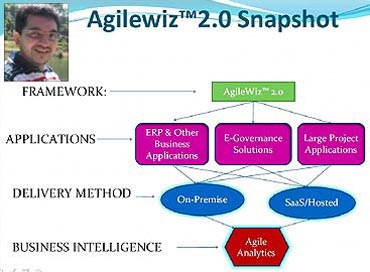
Agilewiz Snapshot.Akshay Shah (29 years)
iWeb Technology Solutions, Mumbai
A business process management generator which can create applications on the fly.
While working in Pune for enterprise resource planning software maintenance and support, Akshay Shah realised that the popular ERPs available in the market were very complex in nature.
He felt the need to develop a software which could churn out on-demand and cost effective applications for business process management. He developed a software platform called AgileWiz, a short form of agile wizard.
The Agilewiz technology is based on the concept of platform-as-a-service which can build fully functional application modules by feeding appropriate metadata as input.
The Agilewiz has a business rules management system (BRMS) which ensures that implementers do not have to repeatedly rely on software principals for critical but necessary customizations of the product.
Shah says that the platform has been designed from ground up and is technology independent. Any ERP, e-governance, hospital management, or a payroll application can be developed quickly using Agilewiz.

Deepak Ravindran.
Deepak Ravindran (22 years)
Innoz Technologies, Haryana
A mobile based search engine to deliver information on any topic.
Deepak Ravindran calls it the "instant cup of knowledge". His mobile based service, SMSGyan, promises information on almost any topic to the user on his mobile phone without asking him to click on any link.
There are a host of services existing which would give users information on certain topics on their mobile phones but most of these are either limited to a sector, such as railway enquiry, or they send links to the user's mobile phone asking the user to click on them to access desired information.
Such services have not become very popular with the vast majority of the people because they don't have GPRS connection on their mobile phones or the connection is weak. Though India has almost 700 million users today, the smart phone penetration still remains very low.
Gyan means "knowledge" in Hindi, and the SMSGyan provides myriad information services which include dictionary, encyclopaedia, job search, health, stock market, and more via text messages.
The idea was seeded when one day, Hisam, one of the founders of Innoz Technologies, was in transit and wanted to know the meaning of a word and found that his basic phone was of no use to get the information. Since the phone had no application and no Internet connection to go to a dictionary and enquire, Hisam had to do without knowing the meaning.
"This kind of a thing has happened to each one of us and it can be frustrating," says Ravindran. The team then sat down to put together an answer engine which would give users answers to various kinds of queries from anywhere at any time.
The SMSGyan platform can work with any number of databases or resources. It delivers mobile-optimized results. These text results support upto a maximum 500 characters of information across all operators in India.
A user would have to type an SMS with the keyword GYAN followed by the query and send it to 56161. For example, to know the stock price of Infosys, a user would have to type "GYAN Stock Infosys" and send it to the specified number.

Aishwarya Lakshmi Ratan.
Aishwarya Lakshmi Ratan (29 years)
Microsoft Research, Bangalore
A hybrid paper, pen, and digital slate solution for a low-cost digital record management system.
Technologies that exist today either require users to use a digital pen and a digital slate, which are not very user-friendly, or they require users to digress totally from pen and paper to a personal digital assistant or a computer-based interaction.
All of these technologies are expensive as compared to a pen and paper medium. And therefore, such technologies have not taken off in countries like India where the masses are still comfortable using pen and paper to write in their regional languages.
Aishwarya Ratan has come up with a low-cost digital system which lets the users have the convenience of using a normal pen and a plain paper to record data and instantly store it in the digital form.
This solution has been piloted with self help groups (SHGs) who microfinance and maintain records of each person's savings and loans. Conventionally, the data was recorded at a site on papers and it was later converted into digital data.
Aishwarya's team chose a low-cost digital slate and pen prototype device that allows handwritten entries, made with the pen on ordinary paper forms placed on the device, to be instantly digitized.

Harit Soni.Harit Soni (27 years)
Ecolibrium Energy, Ahmedabad
Smart grid technology to optimise the use of electricity in India.
Supported by the Ministry of New and Renewable Energy of the Government of India, Ecolibrium is a smart-grid startup aimed at enabling consumers to manage power consumption in real-time. A humungous amount of electricity is wasted because of the lack of a feedback loop between suppliers and consumers.

India has a power deficit of 12 percent with almost 300 million people living without electricity. Transmission losses amount to 1.5 percent of India's gross domestic product. Harit Soni, founder of Ecolibrium Energy, opines that achieving energy efficiency is more cost effective and environment-healthy than setting up new power plants to fulfil India's power demands.
At Ecolibrium Soni has led the development of indigenous smart grid technologies. The smart grid is essentially addition of communication and application layers on top of the existing power transmission layer. Though smart grid technologies are available, India needs a customized solution to address the transmission and distribution losses. 

Krishna Gopal Singh.Krishna Gopal Singh (29 years)
EnNatura Technology Ventures, Delhi
Eco-friendly printing ink that reduces harmful emissions by almost 99 per cent.
The offset printing industry emits 500,000 tons of volatile organic compounds (VOCs) annually into the atmosphere.
These emissions are huge contributors to global warming and are also detrimental to the health of millions of workers in the global print industry.
The major source of pollution is the petroleum components in such inks which are released in the atmosphere as harmful emissions during the drying and the washing processes of printing, causing photochemical smog formation and ozone depletion.
Printers who are exposed to regular emissions are in danger of acquiring respiratory ailments such as tuberculosis and even cancer. The current eco-friendly solutions available in the global market are either expensive or do not produce the same quality output as the widely-available petroleum based inks.
Krishna Gopal Singh, chief technology officer of Ennatura Technology Ventures, Delhi, has formulated a biodegradable printing ink which is mainly composed of the resin, the solvent which is used to dissolve the resin, the color pigment, and additives.
Singh and his team created a functional resin from renewable feedstock so that all the chemical reactions involved in the printing process don't result in emission of volatile organic compounds.
This particular kind of resin is pH-sensitive and the inks formulated with it print well with mildly acidic fountain solutions used in lithography printing.

Manav Bhatia.Manav Bhatia (32 years)
Alcatel-Lucent, Bangalore
Securing the Internet service provider's routing network.
Routing in the Internet is a very complex task and routing protocols play the key role in ensuring that Internet works in a sane way.
And Manav Bhatia's security and authentication algorithms help in making the routing protocols more secure and less susceptible to attacks, such as Denial of Service (DoS) or traffic redirection, so that data transfers happen seamlessly over the Internet.
Having spent a considerable amount of time studying and working in routing protocols, Bhatia started noticing that protocols were not as secure as they were always thought to be.
He looked closely at how these protocols used the cryptographic authentication mechanisms and saw vulnerabilities in almost all the popular protocols deployed in the service provider and enterprise networks. Bhatia worked on the mechanisms that were defined by the Internet Engineering Task Force (IETF) standards and fixed the vulnerabilities.
The IETF is a global community of network designers, operators, and researchers responsible for producing technical specifications for the evolution of the Internet architecture and smooth operation of the Internet.

By Sharath with No comments

Nov 22, 2011

After Steve Jobs: About Dropbox and its whiz-kid creator Drew Houston.


Dropbox founder Drew Houston is an MIT graduate. But what sets this young entrepreneur different is the fact that when Steve Jobs made an offer that he couldn't refuse to buy his intelligent creation, he turned it down without a second thought! 

"I mean Steve friggin' Jobs," quips Houston, who is now just 28. Dropbox is the creation of Drew Houston, and it tries to solve one of the oldest problems the Internet has ever had: How do I access all my files from anywhere I go, no matter what device I am on? Simple it may sound but the statistics of growth for this humble startup is simply startling. The 50-million user figure was only one-third that a year ago, and the revenue is set to hit $240 million in 2011, despite 96% of its user base being free users! Even if Houston is reluctant when it comes to revealing margins, we know this much: the 70 employee team that runs Dropbox, most of them engineers, generate three times more revenue per employee than even industry hulks like Google.

Statistics must be Houston's favourite because they also predict, that the 96% free users are filling their 2GB free accounts at scorching speeds and will soon upgrade to 50GB for $10 a month or 100GB for $20. This means even if no user signs up newly in 2012, his sales will double! "But we will sign up many, many customers". Dropbox has become a verb and has joined the many recent additions to the vocabulary like 'twittering', 'e-mailing', you can now, "Dropbox Me"!


Born in suburban Boston, Houston's father is a Harvard trained Electrical Engineer and mother a high-school librarian. His mother had the intuition that her son is geek material when he started tinkering with an IBM PC Junior at the age of 5! She promptly made him learn French, made him hangout with friends, and never allowed him to skip a grade. At 14 Houston signed up to test online games and was soon rooting out security flaws. The company soon hired him as their network programmer. He worked at startups throughout his high school. Dropbox is his sixth.


By his freshman year at MIT, Houston had largely become what his mom feared most- he was churning out code big time. He was finally convinced by Daniel Goleman's "Emotional Intelligence" that  Intelligence was not all that counted if he was to run his own company. "No one is born a CEO, but no one tells you that" says Houston. “The magazine stories make it sound like Zuckerberg woke up one day and wanted to redefine how the world communicates with a billion-dollar company. He didn’t.” He then went for an MBA or “a crash course in project management and getting people to do stuff for you.”


The idea of dropbox was conceived three months later when he was travelling to NY; having forgotten his USB drive he was left with no code to work on. Frustrated and challenged, he then set to write code for seamless synchronisation of files across different platforms, and voilĂ , four months later he was flying to San Francisco to meet Paul Graham of Incubator Y Combinator, who would later fund his startup.


Impressed by his innovative idea and work done so far, Y Combinator promised funding but insisted he have a co-founder before submitting application. Houston had two weeks; enter Arash Ferdowsi, son of Iranian refugees, studying Computer Science at MIT. After their getting together, Ferdousi dropped out of MIT with just six months to go! With the $15000 from Y Combinator, they could rent an apartment and buy a Mac. Houston and Ferdowsi spent 20 hours a day trying to reverse engineer and make their application fit on Mac.“Devices are getting smarter—your television, your car—and that means more data spread around,” says Houston, “There needs to be a fabric that connects all these devices. That’s what we do.” Months later, they  presented Dropbox at Y Combinator meeting, and from then on there has been no looking back!


Houston and Ferdowsi spent the next year pulling all-nighters. They were perfectionists. One time Houston had to track down a copy of Windows XP for Sweden because it had a unique coding quirk that was stalling Dropbox slightly. Ferdowsi had a designer spend hours tweaking the shade of Dropbox’s button inside the file system on a Mac. It was a touch darker than the Apple buttons, and it drove him “crazy” for weeks. “I am the gatekeeper here,” says Ferdowsi. “Everything has to be just so.”


It was at one of his meetings-over-lunch that he realised how big Dropbox has become. While explaining the concept, someone at the table said, “I know, I use it all the time.” Rather than a tech CEO, his drinking buddy was rapper Will.i.am of the Black Eyed Peas, who told Houston he used Dropbox to collaborate with producer David Guetta on the hit “I Got A Feeling.” Such anecdotes now pour in. After his laptop crashed during final exams one law student wrote in: “Without Dropbox I would have failed out of law school and be living under a bridge.” A watch design firm just outside of Venice, Italian Soul, uses Dropbox to create new pieces with a designer in Mendoza, Argentina, the hulking 3-D files living painlessly in the cloud. Haitian relief workers kept up-to-date records of the deceased and shared those names with Miami and other cities. Professional sports teams inventory videos of opponents’ plays, accessible wherever the team is playing. Last Thanksgiving even the shadowy Ferdowsi, donning a Dropbox hoodie, was mobbed by star-struck teens in an arcade in Kansas City, his hometown. “That’s when I knew we’d hit it,” says Ferdowsi.


As for now,Houston’s estimated 15% stake is worth, on paper, $600 million.

By Sharath with No comments

    • Popular
    • Categories
    • Archives